He had no maps, no instruments, no figures of the speed and direction of the ocean current. He had only one certainty which he had learned in school back home: - the sun gets up in the East and down in the West – always! - the earth therefore rotates from West to East - always! Therefore the prevailing breezes and winds would blow east! Never mind the direction of the ocean currents, his coconut float needed a sail to drift east with a gentle breeze.
He knew that his little island was someplace west of Australia – perhaps some 3000 miles away. With an almost permanently western breeze of perhaps 10.5 miles per hour he estimated that his coconut float could perhaps float about 250 miles a day and reach the coast of Australia in perhaps 12 days. Or miss Australia and perhaps land on New Guinea in 24 days. Perhaps!
There are too many "perhapses" in his estimations and Swiss pirate Telleskopp knew that with such vague figures he needed a large safety factor. He needed to eat and drink every day. He would collect rain water of course, but would it rain just once in 12 days? Perhaps. He will have a hook in the water all the time to catch that lonely fish who got lost in the vastness of the Pacific Ocean – perhaps. Only the full coconuts – one a day – could give him the guarantee to drink and eat every day for 12 days. And with a safety factor of 10 he would need 120 coconuts!
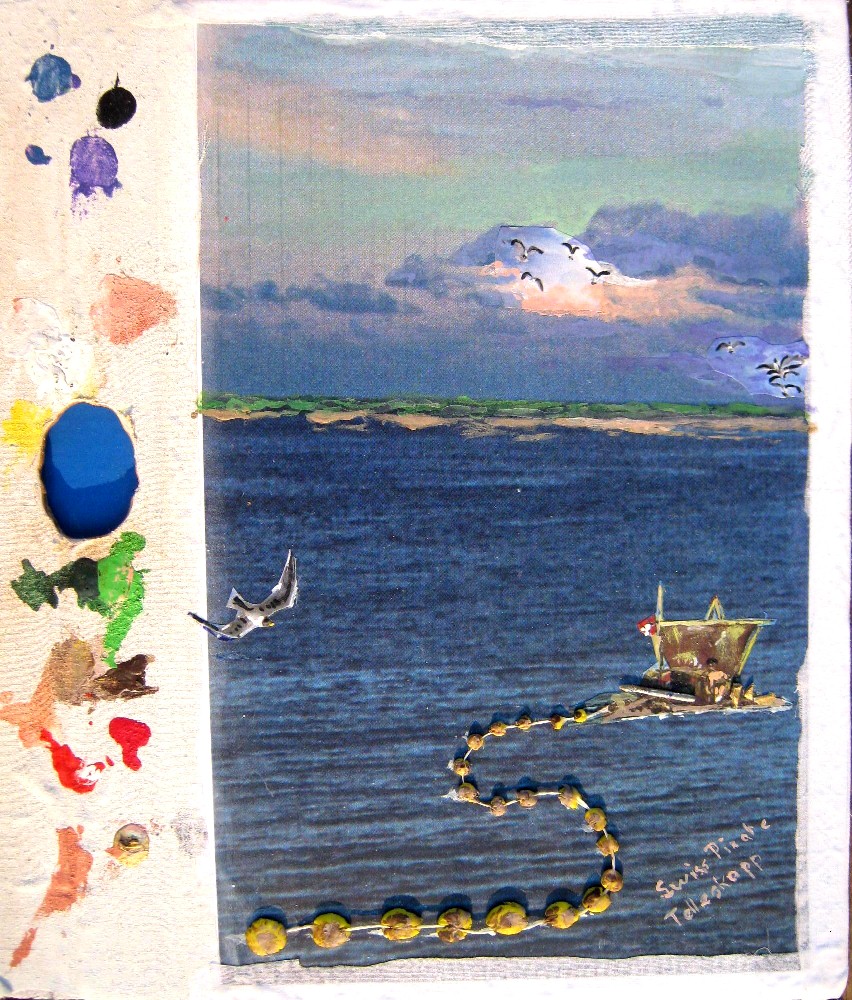
He could not load 120 full coconuts onto his coconut float that could just barely hold himself, his loot and his telescope above water. The 120 full coconuts, his food and drink reserve, had to float on its own, attached one to the other in a long curved tail behind the float. You see it on the cover picture! If you count the coconuts of the tail, you find 20 of them. By pulling one out of the water every day and counting the remaining, Swiss pirate Telleskopp knew how many days he was floating. The coconut tail had become his precision calendar.
You also see birds in the sky and far, far away on the horizon the faint outlines of a coast. Land in sight! Swiss pirate Telleskopp quickly counted the floating coconuts: twenty! He has been floating for 100 days exactly to find land. Is it a big island or a small one? If it is a very big one, it is called a continent. That coastline you see on the cover, is it the continent of Australia or the islands of New Guinea or New Zealand? Swiss pirate Telleskopp doesn’t know yet and we don’t know either. But we will find out. He’ll let us know. One thing is certain already: It is not his tiny little pirate island of the past. He has sailed exactly 100 days east, away from his old home.
Swiss pirate Telleskopp apologizes for the amateurish painting he rendered when he saw land, 100 days after leaving his treasure island. First he saw some sea birds, then a sandy coast line. Land, an island! In his excitement he picked up an old piece of sail and stretched it over a board. He had to hurry; it was getting darker by the minute. Palette and canvas became one and his brush picked up speed in order to catch the moment of sighting land after a 100 days – before the night set in. Tomorrow he will land on some island, small or large. Let him talk for himself: "I want my grandson Alexander to catch the mood of his grandfather when, before night, he saw land, after a 100 day odyssey across the Pacific. Count the remaining coconuts Alexander! Your grandfather had only 20 days left to live. But there, ahead in the night, there is land and new life. Tomorrow I land and continue the journey!"